Therapist Neurodiversity Collective

.Therapy.Advocacy.Education.

Subject: UnitedHealth Is Strategically Limiting Access to Critical Treatment for Kids With Autism, by Annie Waldman

December 15, 2024
ProPublica
Attention: Stephen Engelberg, Editor-in-Chief

Dear Stephen Engelberg,
As avid readers of ProPublica, we express our concern about the ProPublica December 13, 2024 article, “UnitedHealth Is Strategically Limiting Access to Critical Treatment for Kids With Autism,” by Annie Waldman. 

We were surprised to see that the article contained numerous ABA industry talking points that resembled an ABA brochure more than a balanced journalistic approach to this practice, which is widely known to be controversial. The article presents a highly biased positive view of an autism “treatment,” applied behavior analysis (ABA), that the vast majority of Autistic adults consider fundamentally unethical and abusive, and which often results in outcomes of trauma and poor mental health, including PTSD (Anderson,2022; Cerinus, 2022; Freitas, 2020; Hungate, 2020; Kupferstein, 2018; Levinstein, 2018; McGill & Robinson, 2021; Shkedy et al., 2021).

Waldman presented ABA as the sole therapy for helping autistic children when, in fact, most families with autistic children worldwide rely on services provided by speech-language pathologists (SLP) and occupational therapists (OT) (which are not even mentioned in the article). At the same time, ABA, a behavioral approach derived from BF Skinner in the postwar period and abusedly used by Lovaas (UCLA) as conversion therapy for gay and autistic children in the 1960s and 1970s (Pyne, 2020), is now limited mainly to markets in the US and Canada due to numerous concerns about the ethics of this treatment, including violations of fundamental human rights, denial of human dignity, and lack of scientific evidence (The Joint Committee on Disability Matters in Ireland, 2023; United Nations, 2015). 

Waldman’s neglect to mention SLP and OT services is an especially significant erasure because ABA is often wrongly prescribed as a treatment for autistic children rather than essential speech-language and OT services. Approximately 60 to 65% of autistic children have co-occurring speech-motor conditions like Childhood Apraxia of Speech (CAS) (ASHA, 2015), where the individual cannot form and execute the motor plans necessary for the articulation and ordering of sounds in words. By all appearances, the 10-year-old child, Benji, in the ProPublica article, exhibits symptoms of the condition based on the descriptions of his inability to produce single words.

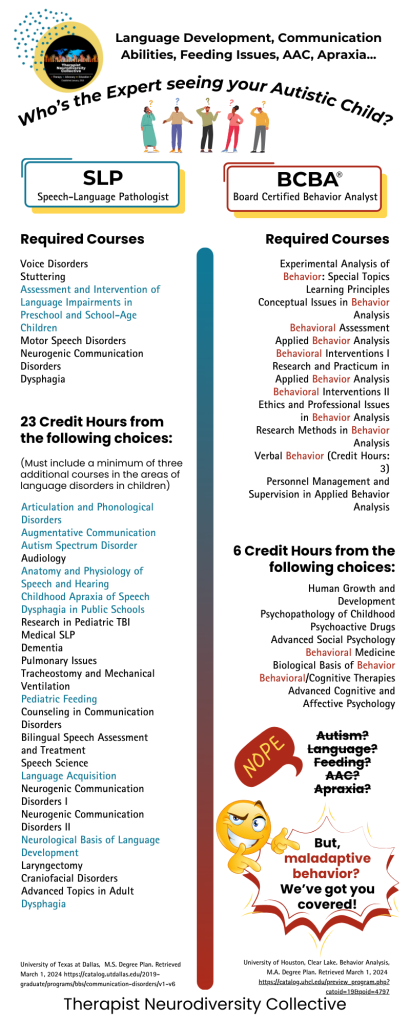
Board-certified behavior analysts (BCBA®) who plan and supervise ABA treatment for autistic young people do not possess clinical or theoretical expertise in autism. BCBAs are not required to take even one graduate-level course in autism, much less courses in communication disorders, including the treatment of co-existing speech-motor conditions that autistic young people struggle with, such as CAS (University of Houston, Clear Lake, 2024).

Nor are BCBAs required to be educated or trained in the evaluation and therapy for implementing Augmentative and Alternative Communication (AAC). AAC would have afforded Benji an authentic, robust mode of communication rather than being painfully limited to producing random single words (out of context) on demand. However, the ProPublica article promotes ABA providers as the “experts” in autism intervention. As Sandoval-Norton and Shkedy have noted: 

“Given that the Behavior Analyst Certification Board (Behavior Analyst Certification Board, 2018) requires no education and training on Autism in general, let alone the cognitive and neurological characteristics of Autism, basic child development, social and interpersonal skills, cultural issues, child autonomy and self-esteem, dietary issues, etc., it is shocking that most have not questioned their current scope in working with children with Autism in the first place” (Sandoval-Norton & Shkedy, 2019).

Additionally, Registered Behavior Technicians ® (RBT) who perform the vast majority of the hours upon hours of ABA treatment that autistic children are subjected to under the supervision of a BCBA, up to 40 hours a week, and in Benji’s case, 33 hours a week, are woefully inadequately trained to provide treatment. The qualifications for RBT are scant: RBTs must be at least 18, have a high school diploma or equivalent, pass a background check, receive 40 hours of training in person or watch 40 hours of video training, and pass an exam (BACB, 2024). 

Research reviews from Cochrane Review (Reichow et al., 2018), Sandbank et al.’s 2020 “Autism Intervention Meta-analysis for Studies of Young Children, and the Project AIM study, “Overview of Issues in Autism Intervention Research: Research Design and Reporting” (Bottema-Beutel et al., 2023) illustrate that there is no clear evidence of benefit and that, alarmingly, harms to the children are not even being considered in ABA research, unlike other autism research. The vast majority of ABA research relies on single case studies with no control group and contains biases including undeclared conflicts of interest, sampling bias, and observer bias (Bottema-Beutel et al., 2021; Eckes et al., 2023); Green et al., 2018; Sandbank et al., 2021). Further, most are published in industry journals that psychologists and other professionals do not consider rigorous. This self-reinforcing approach exists as an echo chamber that is useful for marketing ABA but is not scientifically rigorous by any definition. 

To sum up, ABA is most certainly not the gold standard of autism treatment.

To sum up, ABA is most certainly not the gold standard of autism treatment, and Benji’s insurance provider, as autism research continues to demonstrate, is correct in that ABA treatment is wholly ineffective in improving the communication abilities of autistic children or even the symptoms of autism. Over the next decade, we can expect more insurers to conduct evaluations of the return on investment (ROI) for ABA and the ROI for emerging, neurodiversity-affirming approaches that families are increasingly seeking. Indeed, the Department of Defense studied the outcomes of ABA treatment for the thousands of autistic children insured by Tricare, one of the largest insurers in the US, and found “no noticeable effects on communication/language competencies, social-emotional development/behavior, and functional abilities” and “little to no change in symptom presentation” for the participants. These assessments are in the interest of patients when they lead to better coverage for newer and more ethical and trauma-informed therapies, as well as to confirm the efficacy of established scientific methods like SLP and OT.

A hard copy of this letter has been mailed to the ProPublica office in New York.

Sincerely,

Julie Roberts, M.S., CCC-SLP, on behalf of Therapist Neurodiversity Collective
Anne Borden, on behalf of Autistics for Autistics: Self Advocacy in Canada

We've yet to receive an acknowledgement of our December 15, 2024 letter, much less a response from ProPublica's editor.

Endnotes:

       Anderson, L. K. (2022). Autistic experiences of applied behavior analysis. Autism, 0(0). https://doi.org/10.1177/13623613221118216
       American Speech-Language-Hearing Association. (2015). Apraxia a Common Occurrence in Autism, Study Finds. The ASHA Leader, 20, 18. https://leader.pubs.asha.org/doi/10.1044/leader.RIB1.20092015.18
       BACB. The Registered Behavior Technician® (RBT®) is a paraprofessional certification in behavior analysis. https://www.bacb.com/rbt/
       Bottema-Beutel, K., Crowley, S., Sandbank, M., & Woynaroski, T. G. (2021). Research Review: Conflicts of Interest (COIs) in autism early intervention research: A meta-analysis of COI influences on intervention effects. Journal of Child Psychology and Psychiatry, and Allied Disciplines, 62(1), 5. https://doi.org/10.1111/jcpp.13249
       Bottema-Beutel, K., Sandbank, M., & Woynaroski, T. (2023). Overview of Issues in Autism Intervention Research: Research Design and Reporting. SIG 1 Language Learning and Education. https://doi.org/23814764000300140072
       Cerinus, A. (2022). A Response to” Thou Shall Not Ration Justice”: Applied Behavior Analysis Causes Harm. J. Legis., 49, 389. https://scholarship.law.nd.edu/cgi/viewcontent.cgi?article=1756&context=jleg
       Eckes, T., Buhlmann, U., Holling, H. D., & Möllmann, A. (2023). Comprehensive ABA-based interventions in the treatment of children with autism spectrum disorder – a meta-analysis. BMC psychiatry, 23(1), 133. https://doi.org/10.1186/s12888-022-04412-1
       Freitas, Brittany Garcia (2020). Questioning Normativity: Exploring the Experiences of Autistic Adults Who Have Undergone Applied Behavioural Analysis (ABA). Toronto Metropolitan University. Thesis. https://doi.org/10.32920/ryerson.14663727.v1
       Green, J., & Garg, S. (2018). Annual Research Review: The state of autism intervention science: progress, target psychological and biological mechanisms and future prospects. Journal of child psychology and psychiatry, and allied disciplines, 59(4), 424–443. https://doi.org/10.1111/jcpp.12892
       Hungate, C. A. (2020). The possible harms of ABA therapy on individuals with autism. https://cardinalscholar.bsu.edu/server/api/core/bitstreams/194f31d5-a1e7-4fbd-8c29-e567ab7c90aa/content
       Joint Committee on Disability Matters (Ireland). Aligning Disability Services with the United Nations Convention on the Rights of Persons with Disabilities. February 2023.
       Kupferstein, H. (2018). Evidence of increased PTSD symptoms in autistics exposed to applied behavior analysis. Advances in Autism, 4(1), 19-29. https://www.emerald.com/insight/content/doi/10.1108/AIA-08-2017-0016/full/html
       Levinstein, Kathleen P. (2018) “Distorting Psychology and Science at the Expense of Joy: Human Rights Violations Against Human Beings with Autism Via Applied Behavioral Analysis,” Catalyst: A Social Justice Forum: Vol. 8: Iss. 1, Article 5.  https://trace.tennessee.edu/catalyst/vol8/iss1/5/
       McGill, O. and Robinson, A. (2021), “Recalling hidden harms”: autistic experiences of childhood applied behavioural analysis (ABA)”, Advances in Autism, Vol. 7 No. 4, pp. 269-282. https://doi.org/10.1108/AIA-04-2020-0025
       Pyne J. “Building a Person”: Legal and Clinical Personhood for Autistic and Trans Children in Ontario. Canadian Journal of Law and Society / Revue Canadienne Droit et Société. 2020;35(2):341-365. doi:10.1017/cls.2020.8 https://www.cambridge.org/core/journals/canadian-journal-of-law-and-society-la-revue-canadienne-droit-et-societe/article/building-a-person-legal-and-clinical-personhood-for-autistic-and-trans-children-in-ontario/2041374EDCDAD44AE2DE1EB9D2C16361
       Reichow B, Hume K, Barton EE, Boyd BA. Early intensive behavioral intervention (EIBI) for young children with autism spectrum disorders (ASD). Cochrane Database Syst Rev. 2018 May 9;5(5):CD009260. doi: 10.1002/14651858.CD009260.pub3. PMID: 29742275; PMCID: PMC6494600. https://www.ncbi.nlm.nih.gov/pmc/articles/PMC6494600/
       Sandbank, M., Bottema-Beutel, K., Crowley, S., Cassidy, M., Dunham, K., Feldman, J. I., Crank, J., Albarran, S. A., Raj, S., Mahbub, P., & Woynaroski, T. G. (2020). Project AIM: Autism intervention meta-analysis for studies of young children. Psychological bulletin, 146(1), 1–29. https://doi.org/10.1037/bul0000215
       Sandbank, M., Bottema-Beutel, K., & Woynaroski, T. (2021). Intervention Recommendations for Children With Autism in Light of a Changing Evidence Base. JAMA Pediatrics, 175(4), 341- 342. doi:doi:10.1001/jamapediatrics.2020.4730 https://pubmed.ncbi.nlm.nih.gov/33165523/
       Shkedy, G., Shkedy, D. & Sandoval-Norton, A.H. Long-term ABA Therapy Is Abusive: A Response to Gorycki, Ruppel, and Zane. Adv Neurodev Disord 5, 126–134 (2021). https://doi.org/10.1007/s41252-021-00201-1
       United Nations. (2015, April 1). Discrimination against autistic persons, the rule rather than the exception – UN rights experts. https://www.ohchr.org/en/press-releases/2015/04/discrimination-against-autistic-persons-rule-rather-exception-un-rights
       University of Houston, Clear Lake. Behavior Analysis, M.A. Degree Plan. Retrieved March 1, 2024. https://catalog.uhcl.edu/preview_program.php?catoid=19&poid=4797

Letter to the Editor of ProPublica in Response to ” UnitedHealth Is Strategically Limiting Access to Critical Treatment for Kids With Autism”

Subject: UnitedHealth Is Strategically Limiting Access to Critical Treatment for Kids With Autism, by Annie Waldman
Dear Stephen Engelberg,
As avid readers of ProPublica, we express our concern about the ProPublica December 13, 2024 article, “UnitedHealth Is Strategically Limiting Access to Critical Treatment for Kids With Autism,” by Annie Waldman…

Read More »

IEPs, Ableist Goals and Parents’ Rights

A neurodiversity-affirming parent’s anonymous post to Therapist Neurodiversity Collective requested information that might help them advocate for their special education student in the IEP meeting. From the information contained in the post, it appeared that the school, although possibly unintentionally, was not aware of IDEA and Supreme Court decisions, and therefore violated parental rights to meaningfully participate in and contribute to the IEP meeting. Additionally, it is clear that our public school system is lagging in knowledge and application of contemporary research evidence about autism, and as a result, the kids are paying the consequences with poor mental health outcomes. 

Read More »
Picture of young student with brown hair, head in hands, sitting at desk.

Not allowed to say “I can’t”

“The kids in my class aren’t allowed to say I can’t.” I’m in an IEP meeting for young neurodivergent student who’s struggling in class. The committee is talking about all the reasons why this student should not be struggling because their standardized cognitive and language scores show they have the ability to learn and do the work.

Read More »
Julie Roberts, M.S. CCC-SLP