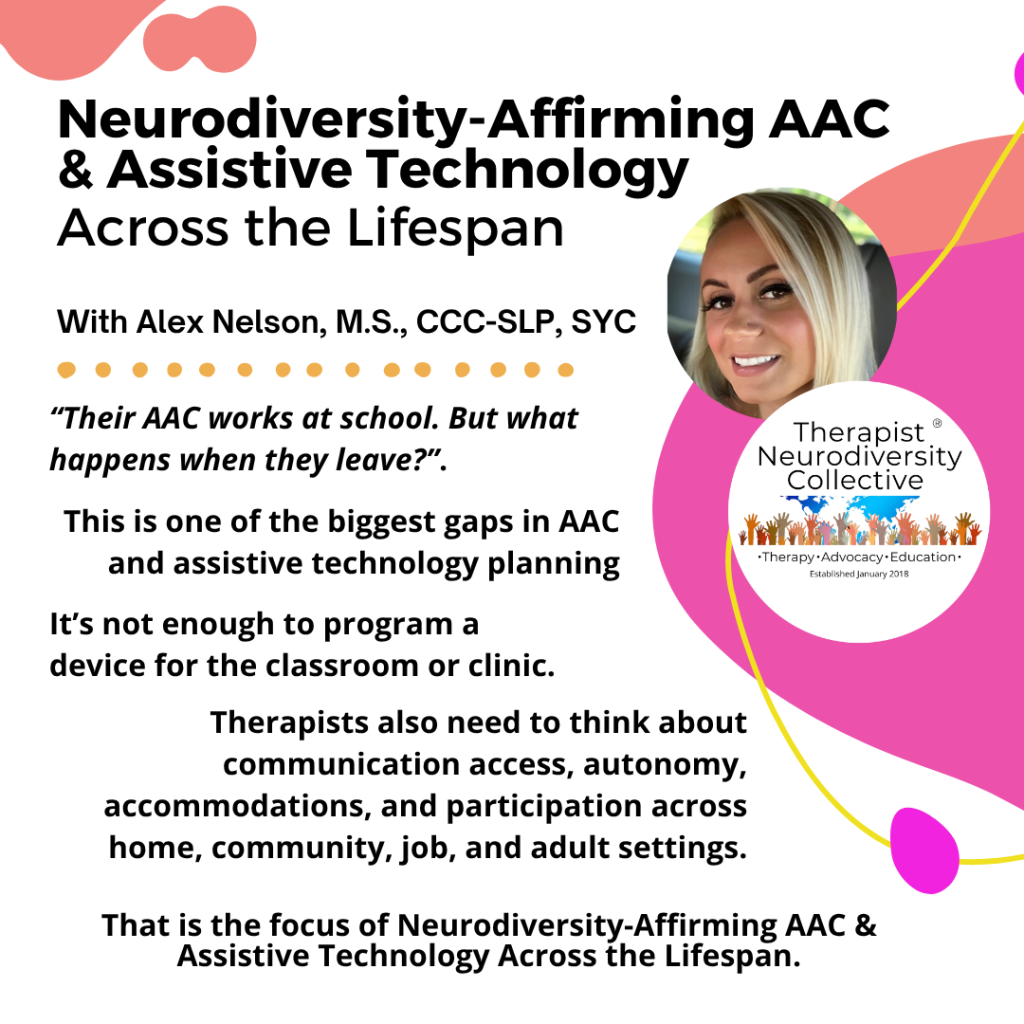
This is one of the biggest gaps in AAC and assistive technology planning.
It’s not enough to program a device for the classroom or the clinic. We also need to think about communication access, autonomy, accommodations, and participation across home, community, job, and adult settings.
That is the focus of Neurodiversity-Affirming AAC & Assistive Technology Across the Lifespan.
Through discussion of high-tech AAC and AT, accommodations, programming across settings, goal development, and case examples, participants will explore practical ways to support complex communicators with multiple disabilities, including those with motor-planning differences, across the lifespan. Particular attention will be given to designing supports that remain meaningful beyond the classroom and clinic and that promote communication access, participation, and autonomy as AAC users transition into adulthood.
Details:
► Featuring: Alexandra (Alex) Nelson, M.S., CCC-SLP, SYC in Educational Leadership
► November 18 2026 @ 4pm Pacific, 6pm Central, 7pm Eastern
► Can’t make the live course? Don’t worry. Enrolles have access to the course recording and materials for a minimum of 14 days after the live course concludes.
► 2 hours of Professional Development credit
► Audience: Speech-language pathologists, occupational therapists, educators, parents and caregivers, and others supporting children, teens, and adults with complex communication and motor planning needs.
🔓🔓🔓 (Therapy Neurodiversity Collective Members, this short course is included in your membership!)
✨ Included:
☑ Handouts
☑ Certificate of Attendance for 2 hours of professional development
 Therapist Neurodiversity Collective Inc. ®